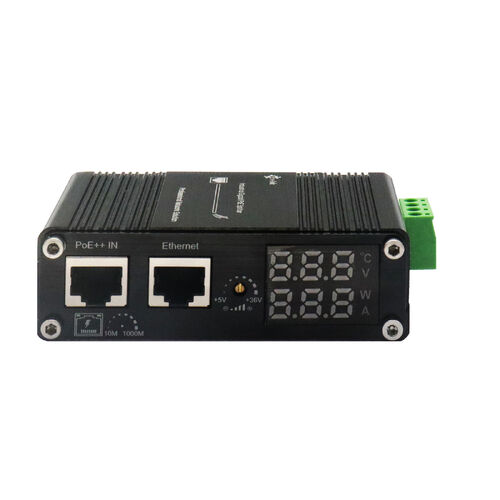
E-link Debuts World-First AI Smart Managed 90W PoE++ Industrial Fiber Media Converter with Voltage Booster
2026-10-26
E-link Launches the LNK-AIMC102GMP90-SFP: A World-First AI Smart Managed 90W PoE++ Industrial Media Converter
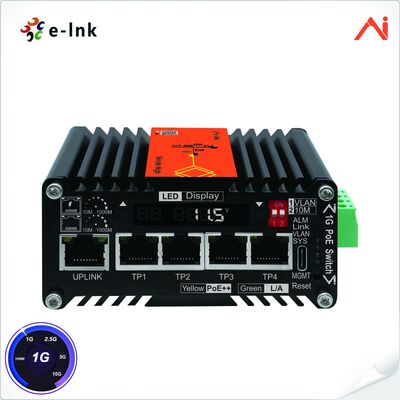
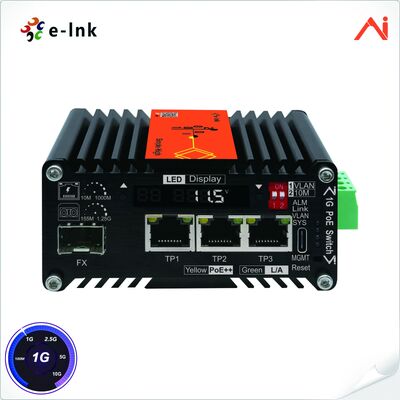
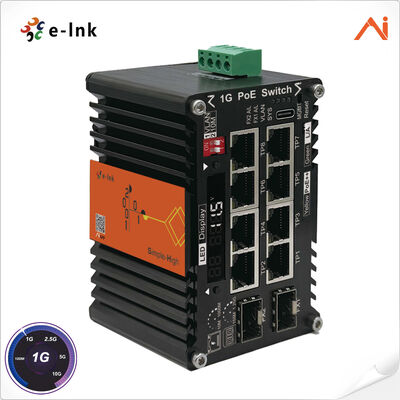
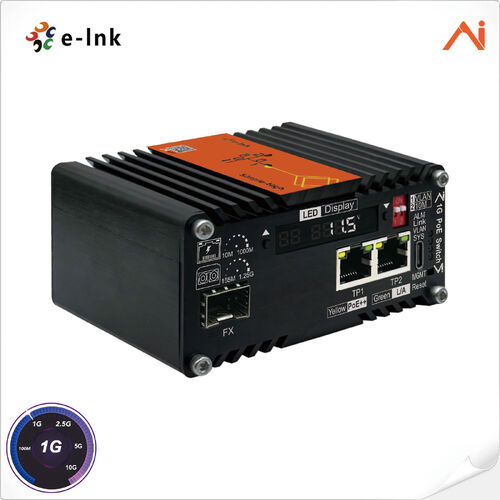
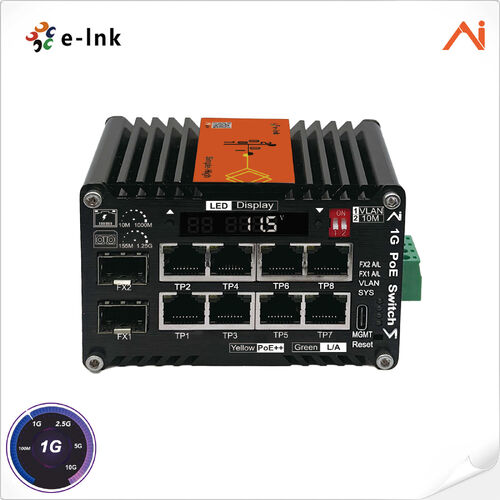
Shenzhen, China — E-link, a professional manufacturer of industrial Ethernet and fiber-optic transmission equipment, today announced the release of the LNK-AIMC102GMP90-SFP, a mini industrial AI smart managed PoE++ fiber media converter with an integrated voltage booster circuit. The new model introduces a genuinely new product category: it merges the plug-and-play simplicity of an unmanaged switch with the full telemetry of a managed platform, and it is purpose-built for solar-powered, off-grid and harsh outdoor network deployments.
The device is equipped with 2× 10/100/1000Base-T RJ45 PoE++ ports plus 1× 100/1000BASE-X SFP fiber uplink port, and delivers up to 90 watts of PoE++ power per port in full compliance with the IEEE 802.3af/at/bt PSE standard. Because the built-in booster accepts a wide 9–54VDC input and steps it up to a stable 48V PoE output, low-voltage DC sources such as 12V or 24V solar battery banks can now drive high-power field equipment — PTZ cameras, 5G CPEs, radar units and satellite terminals — without any additional inverter.
Voltage Booster Performance
DC Input
PoE Output
Max PoE Power
9–12 VDC
48 V
60 W
19–24 VDC
48 V
120 W
24–36 VDC
48 V
120 W
48–54 VDC
48 V
180 W
Customizable versions are also available for Starlink Gen 2 (150 W) and Gen 3 (200 W) compatibility, with 48–56 VDC input and support for both Mode A and Mode B power feeding across pins 1/2(+) and 3/6(−), 4/5(+) and 7/8(−).
Real-Time Visibility Without Extra Test Tools
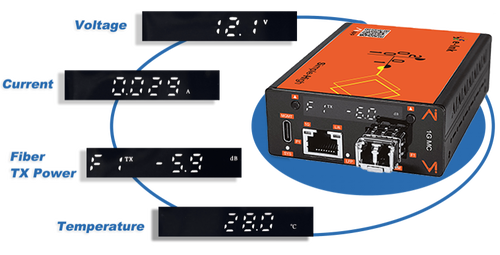
Engineers can inspect the device through three independent channels: an Android mobile APP, a PC web management interface (Edge, Chrome and Opera 89+ on Windows and macOS), and a one-click LED screen real-time data dashboard. The dashboard surfaces system current, voltage and internal temperature, SFP transmit/receive optical power, and Ethernet and fiber port link speeds at a glance.
Diagnostic data covers temperature, voltage, current, RJ45 port link status and rate, VLAN assignment, PSE supply voltage, PSE power consumption, power pin assignment, and complete SFP DDM parameters including optical power, wavelength, transmission distance, link rate and module temperature. Operators can set customizable optical power alarm thresholds and schedule automated port or device reboots.
Managed Functions Engineered for Unattended Sites
Fiber port alarm — a red ALM LED triggers whenever received optical power falls below the configured threshold
Scheduled system reset and scheduled PoE power restart for remote maintenance cycles
One-click VLAN isolation and 10M / 250 m long-reach transmission mode via DIP switch
Redundant auto-recovery — if the destination port of a packet is link-down, traffic is forwarded to the backup pair
6 kV lightning surge protection on all ports and dual redundant power inputs for 24×7 uptime
Key Specifications
Parameter
Specification
Switching capacity
10 Gbps, non-blocking
Processing type
Store-and-forward, 1,488,000 pps at 1000 Mbps
Packet buffer / max frame
1 Mbit / 9K bytes
Fiber distances
MMF 550 m / 2 km; SMF 20 / 40 / 80 / 100 / 120 / 160 / 200 km
Housing & mounting
IP40 aluminum case, DIN-rail, 98 × 67 × 46 mm, 300 g
Operating temperature
−40 °C to +75 °C (−40 °F to 167 °F)
Power consumption
5 W max. (PoE not used)
MTBF
> 200,000 hours
Approvals
ISO9001, CE, FCC Part 15 Class A, RoHS; EN55022 Class A, IEC 61000-4-2/3/4/5/6/8
Typical Application Scenarios
Intelligent manufacturing & automation — data transmission and multi-device interconnection
Power & new energy — solar and off-grid surveillance communication, cluster networking
Rail transit & tunnel engineering — real-time video monitoring and signal transmission
Oil, gas and mining sites — stable communication in explosive or remote areas
Smart city and new infrastructure, plus autonomous driving, humanoid robots, AI computing clusters, metallurgy, chemical engineering, outdoor research stations and field weather monitoring
Availability
The LNK-AIMC102GMP90-SFP is available now for sampling and volume orders. SFP modules are purchased separately through E-link's SFP options program, and an optional 240 W / 5 A 48 VDC power supply with open-wire terminal block is offered for fast field commissioning. A DIN-rail bracket is included by default.
For pricing, datasheets and OEM customization, contact the E-link sales team at sales@e-linkchina.com, +86 755-8312 8674, or visit www.e-linkchina.com.cn.
Read More


 Your message must be between 20-3,000 characters!
 english
 français
 Deutsch
 Italiano
 Русский
 Español
 português
 Nederlandse
 ελληνικά
 日本語
日本語
 한국
한국
 العربية
 हिन्दी
 Türkçe
 indonesia
 tiếng Việt
 ไทย
ไทย
 বাংলা
বাংলা
 فارسی
فارسی
 polski